
Gourmet Map of Japan
Gourmet Map
of Japan
Many places claim to have "Japan's tastiest" specialty. This guide takes a different approach: every recommendation is backed by public data - landing volumes and production figures - with the source and statistical year always shown. Each page covers the season, how to choose well, how to eat it, and the routes to buy it, receive it through Furusato Nozei, or eat it at the source. The pilot's three ports - Choshi, Kushiro, and Yaizu - and Ibaraki's brand wagyu, Hitachi beef, are now joined by ten winter specialties (crabs, scallops, pufferfish, anglerfish, tuna, salmon, and wagyu): 14 themes in all. A third wave adds five more - red snow crab of Sakaiminato, sea urchin of Rishiri and Rebun, Yonezawa beef, Kagoshima black pork, and firefly squid - for 19 themes in total.
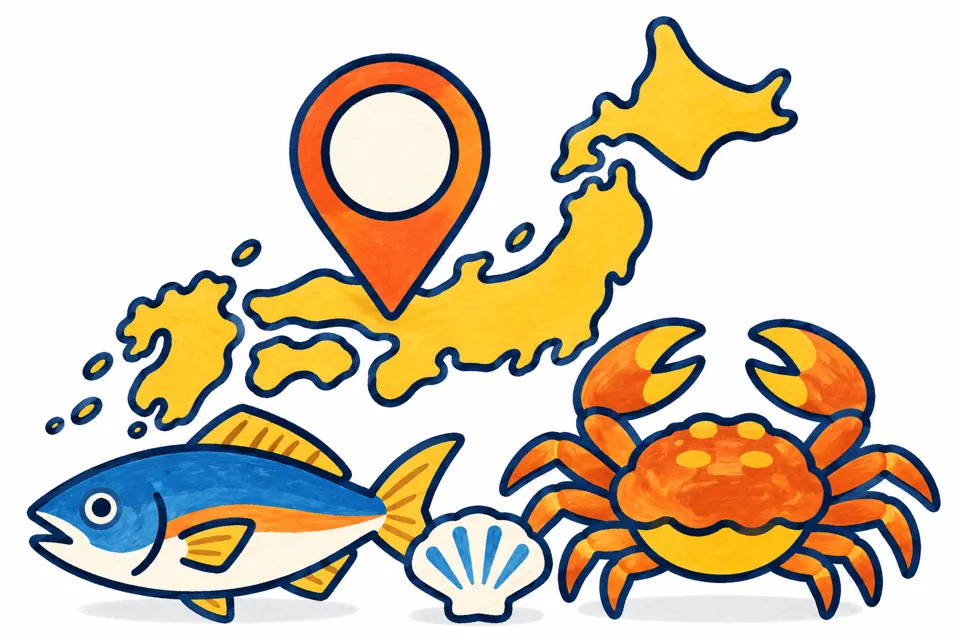
From the Map
Explore by Region & Port
The orange dots mark each theme's home region. Select a dot or a name to open that theme's page.
This is a schematic map showing the relative positions of Japan's regions (not an accurate coastline). The orange dots mark each theme's home; select a dot or a name to open its page.
Pilot Ports
The Three Pilot Ports
Choshi - Japan's top port by volume
No.1 in landing volume for 12 straight years (2011-2022), and again in 2025 with 223,902 tonnes (City of Choshi). The star is the sardine, especially the fatty "Nyubai iwashi" of June-July. Includes a first-hand account from the site owner, who lived there.
Kushiro - the North's landing hub
Japan's top port by total landing volume in both 2023 and 2024. Sardines make up about 80% of its landings, and it is also known for Pacific saury.
Yaizu - Japan's top port by value
No.1 in landing value for eight straight years through 2023, and back on top in 2025 at about 46.9 billion yen. A distant-water base for bonito and tuna.
From the Land
From the Land
Hitachi Gyu - brand wagyu, grades 4 and above only
Ibaraki's brand beef: only Kuroge wagyu from designated producers, graded at meat quality 5 or 4, may carry the name. Sales hit a record 11,917 head in fiscal 2025 - over 10,000 head a year, among the largest brand-wagyu operations in Japan. Includes the top-tier Kirameki brand.
Why include the land?
Fish are ranked by landing volume, but livestock rests on production numbers and grading standards, and farm products on production statistics. For each field, this guide uses the most solid public data and official definitions available.
Ten winter themes were added in the second wave, and five more - red snow crab, sea urchin, Yonezawa beef, Kagoshima black pork, and firefly squid - in the third (see the lists below). More will follow - Kesennuma (shark fin and fresh bonito) and more - as soon as each claim is verified against public data.
Wave 2 · Winter
Second Wave: Ten Winter Specialties
Matsuba Crab of Tottori
No.1 by prefecture for snow crab landings in 2024 (564 t). The deep sand-and-mud grounds of the Sea of Japan, landed at Tottori's ports.
Echizen Gani of Fukui
The only snow crab registered as a GI (No. 69, 2018). A good ground lies close off the Echizen coast, and freshness is protected by on-board sorting and cold storage.
Snow Crab of Hyogo's Tajima Ports
No.2 by prefecture in 2024 (545 t). Five ports along the Tajima coast each run their own tagged brand: Tsuiyama, Shibayama, Kasumi, Hamasaka, Moroyose.
Scallops of Hokkaido (Sarufutsu)
No.1 by prefecture for scallop production (about 425,100 t in 2022). Drift ice brings nutrients, and vast shallow grounds make seabed seeding work.
Pufferfish of Shimonoseki
Japan's only pufferfish-only wholesale market, Haedomari, handles about 80% of the nation's fugu. 'Shimonoseki Fuku' was the first seafood GI (No. 19, 2016).
Anglerfish of Ibaraki & Shimonoseki
Shimonoseki Port leads Japan's ports for anglerfish landings (197 t in 2024). Ibaraki is the eastern home of monkfish culture - 'fugu in the west, ankou in the east'.
Oma Tuna of Aomori
A brand measured by price: Oma bluefin set the all-time first-auction record again in January 2026 - 510.3 million yen for a 243 kg fish.
Salmon & Ikura of Hokkaido
No.1 by prefecture for salmon and trout landings (49,400 t in 2024). Homing instincts plus a century of hatchery releases - though the catch is now in steep decline.
Kobe Beef of Hyogo
GI No. 3 (2015). Only Tajima cattle meeting the strictest thresholds - marbling BMS No.6 or above - may use the name.
Omi Beef of Shiga
GI No. 56 (2017). Kuroge wagyu raised longest in Shiga. In the Edo period the Hikone domain sent beef miso pickles to the shogun's house as a health tonic.
Wave 3 · Spring Light
Third Wave: a Deep-Sea Crab, Northern Urchin, Southern Black Pork, and the Light That Announces Spring
Red Snow Crab (Sakaiminato)
No.2 prefecture in 2024 (2,225 t) - but the real strength is concentration: landings and processing gather at Sakai Port. A deep-sea crab with a long September-June season and friendlier prices than snow crab.
Sea Urchin (Hokkaido - Rishiri & Rebun)
Hokkaido lands 56.8% of Japan's sea urchin (4,091 t in 2023). The pinnacle is the Ezo-bafun uni of Rishiri and Rebun, raised on Rishiri kelp.
Yonezawa Beef (Okitama, Yamagata)
GI No. 26 (2017). The definition demands uncalved Kuroge heifers raised for 33 months or more - long fattening. Famous too for the 1875 story of the English teacher Dallas.
Kagoshima Kurobuta (Kagoshima)
Berkshire only, plus 60 or more days of sweet-potato feed in late fattening. A comeback brand: black pigs fell to 1.6% of the prefecture's pig shipments in 1975 before the prefecture and its farmers revived them.
Firefly Squid (Toyama Bay & Hamasaka)
Hyogo leads the prefectures by catch (4,016 t in 2022). Toyama Bay's swarming sea is a Special Natural Monument - 'volume in Hyogo, quality in Toyama'.
Season Calendar
Season Calendar
Most fish and farm products have a "shun" - the season when they taste best and are most plentiful. This table lists the peak months of specialties whose seasons are documented. The pilot ports' specialties are marked with their home ports.
| Month | Specialties in season (main) |
|---|---|
| Jan | Matsuba crab, Oma tuna, pufferfish, anglerfish, scallops |
| Feb | Pufferfish, anglerfish, Matsuba crab |
| Mar | Firefly squid (Toyama Bay & Hamasaka), spring shirasu, spring cabbage (Choshi) |
| Apr | First bonito (Yaizu), white shrimp, new tea, spring cabbage (Choshi) |
| May | First bonito (Yaizu), new tea, fresh bonito (Kesennuma) |
| Jun | Nyubai sardines (Choshi), sea urchin (Rishiri & Rebun), fresh bluefin tuna (Sakaiminato), cherries, Yubari melon |
| Jul | Nyubai sardines (Choshi), sea urchin (Rishiri & Rebun), Yubari melon, eel, cherries |
| Aug | Nijisseiki pear, scallops, Pacific saury (Kushiro / Nemuro) |
| Sep | Pacific saury (Kushiro), returning bonito (Yaizu), red snow crab season opens (Sakaiminato) |
| Oct | Pacific saury, returning bonito (Yaizu), apples, Oma tuna |
| Nov | Matsuba crab season opens, red snow crab, anglerfish |
| Dec | Pufferfish, Matsuba crab, Oma tuna |
Seasons are general guides to fishing and shipping periods and shift from year to year. Each specialty page explains its season in detail, with sources.
Data with Sources
Japan No.1 Data (with Sources)
Whenever this guide says "No.1 in Japan", it names the statistic and the year. Rankings change with the counting method, so we always state which count we mean.
| Category | No.1 | Basis (statistic, year) |
|---|---|---|
| Port landing volume (2025) | Choshi Port, 223,902 t | City of Choshi announcement (as of Dec 24, 2025); Minato Shimbun tally |
| Port landing volume (2024) | Kushiro Port, 173,659 t | National major-port landing survey (Hachinohe City statistics). Kushiro also led the MAFF Fisheries Distribution Survey's listed landings at about 174,000 t |
| Port landing value (2025) | Yaizu Port, about 46.9 billion yen | City of Yaizu landing statistics |
| Port landing value (2023) | Yaizu Port, about 50.9 billion yen (8th straight year at No.1) | City of Yaizu; Minato Shimbun tally |
| Sardine-class landings by prefecture | Chiba Prefecture | Based on MAFF statistics (prefectural / industry sources) |
| Spring cabbage harvest (by municipality, seasonal) | Choshi City, 39,600 t | MAFF Vegetable Production & Shipment Statistics, 2023 crop (Kanto Regional Agricultural Administration Office) |
| Tuna landing volume | Yaizu Port (about one third of Japan's tuna landings) | Yaizu Port statistics and other sources |
The Basis for the Ten Second-Wave Themes
The second-wave themes rest on different kinds of evidence - landing statistics, Geographical Indication (GI) registrations, and distribution volumes. We label the kind for each theme, so it is always clear which yardstick a "No.1" uses.
| Theme | Type of basis | Basis (statistic / registration, year, value) |
|---|---|---|
| Matsuba Crab of Tottori | By prefecture | MAFF Fisheries & Aquaculture Production Statistics, 2024 - snow crab 564 t, No.1 of 2,387 t nationwide |
| Echizen Gani of Fukui | Brand (GI) | MAFF Geographical Indication No. 69, registered September 27, 2018 - the only GI snow crab. Snow crab landings 466 t in 2024, No.3 by prefecture |
| Snow Crab of Hyogo's Tajima Ports | By prefecture | MAFF Fisheries & Aquaculture Production Statistics, 2024 - snow crab 545 t, No.2 |
| Scallops of Hokkaido (Sarufutsu) | By prefecture | MAFF Fisheries & Aquaculture Production Statistics, 2022 - scallops about 425,100 t (catch + aquaculture), No.1 |
| Pufferfish of Shimonoseki | Distribution | Haedomari Market handles about 80% of Japan's pufferfish (City of Shimonoseki). 'Shimonoseki Fuku' - MAFF GI No. 19, registered October 12, 2016, the first seafood GI |
| Anglerfish of Ibaraki & Shimonoseki | By port | Yamaguchi Prefecture survey, 2024 - Shimonoseki Port 197 t, No.1 among ports; Hirakata Port, Ibaraki, is the eastern centre |
| Oma Tuna of Aomori | Brand (price) | Toyosu Market first auction - an Oma bluefin of 243 kg sold for 510.3 million yen on January 5, 2026, the highest price on record (Tokyo Metropolitan Central Wholesale Market) |
| Salmon & Ikura of Hokkaido | By prefecture | MAFF Fisheries & Aquaculture Production Statistics - salmon & trout 89,266 t in 2022 and 49,400 t in 2024, No.1 in both years |
| Kobe Beef of Hyogo | Brand (GI) | MAFF Geographical Indication No. 3, registered December 22, 2015 - Tajima cattle graded yield A/B, quality 4 or above, marbling BMS No.6 or above |
| Omi Beef of Shiga | Brand (GI) | MAFF Geographical Indication No. 56, registered December 15, 2017 - Kuroge wagyu raised longest within Shiga Prefecture; about 6,000 head shipped a year (association figure) |
The Basis for the Five Third-Wave Themes
The third wave rests on prefectural statistics, a GI registration, a breeders' code, and a cultural-property designation - whichever yardstick is firmest for each theme. Where a ranking swaps between years, as with firefly squid, we say so.
| Theme | Type of basis | Basis (statistic / registration, year, value) |
|---|---|---|
| Red Snow Crab (Sakaiminato) | By prefecture / concentration | MAFF Fisheries & Aquaculture Production Statistics, 2024 - Tottori 2,225 t, No.2 (Shimane No.1 at 2,273 t; national total 12,345 t). About 50-60% of Japan's catch is landed at Sakai Port (Tottori Prefecture and Sakaiminato City materials) |
| Sea Urchin (Hokkaido) | By prefecture | MAFF Fisheries & Aquaculture Production Statistics, 2023 - Hokkaido 4,091 t, 56.8% of the national 7,204 t, No.1 |
| Yonezawa Beef (Yamagata) | Brand (GI) | MAFF Geographical Indication No. 26, registered March 3, 2017 - uncalved Kuroge heifers, 33 months or older (raised from 32 months in December 2023), meat quality grade 3 or above |
| Kagoshima Kurobuta (Kagoshima) | Prefectural brand (breeders' code) | Kagoshima Black Pig Producers' Association rules - Berkshire only, 60+ days of feed containing 10-20% sweet potato in late fattening; the name was trademarked in 1999 |
| Firefly Squid (Toyama Bay & Hamasaka) | By prefecture / cultural property | MAFF Fisheries & Aquaculture Production Statistics, 2022 - Hyogo 4,016 t (58.8%), No.1. Toyama Bay's 'Firefly Squid Swarming Sea' was designated a Special Natural Monument in 1952 |
On each detail page, the source, the data check date, and the update rule are shown in this fixed format at the foot of the page (the common format for all pages).
Our Promise
Our Promises
Every number carries a source and a year
Rankings change every year. We state which statistic, from which year, makes a specialty "No.1", and we update figures as new data appears.
First-hand accounts are kept separate from data
Where the site owner has lived, we add a personal account - visually separated from the statistics and clearly labelled as a personal impression. We never write testimonials for places without first-hand experience.
Furusato Nozei
Furusato Nozei: Receive It as a Hometown-Tax Gift
Japan's Furusato Nozei system lets taxpayers donate to a municipality of their choice and receive a local specialty as a thank-you gift, with most of the donation deducted from their taxes. Choshi's specialties are available as gifts. Our Furusato Nozei guide (in Japanese) explains the system and the deduction limits in detail. When searching for gifts, filter the portal by the municipality name - "Choshi City" - to find them reliably. (The system is for taxpayers in Japan.)
* Furusato Nozei is a donation, not a purchase. Deduction limits apply, and a procedure (the One-Stop exception or a tax return) is required. See the guide for details.