
Red Snow Crab and Sakaiminato: the Port Where 50-60% of Japan's Catch Gathers
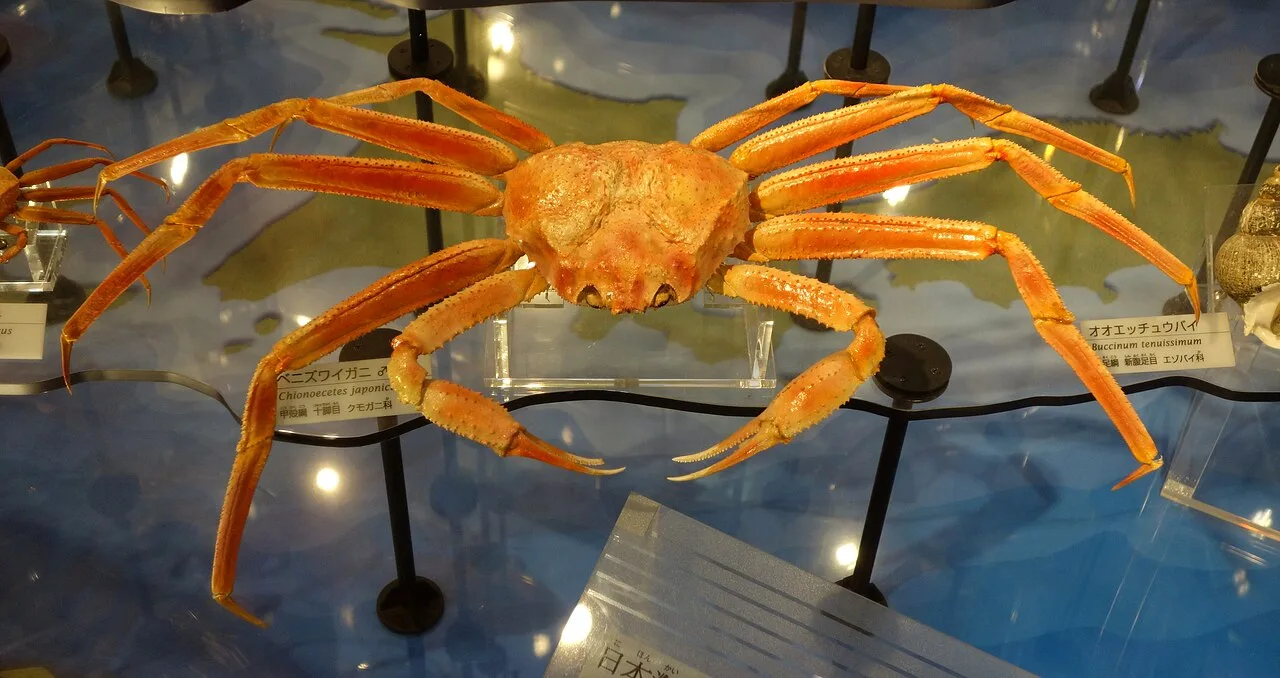
The red snow crab (beni-zuwaigani) lives 400 to 2,700 metres down in the deep sea. A cousin of the snow crab, it is red even before cooking - hence the name. By prefecture, Tottori ranked No. 2 in 2024, but the true star is the port: Sakai Port in Sakaiminato, home base of the minister-licensed fleet and ringed by processing and distribution facilities, receives about 50-60% of Japan's landings. With a long season from September to June and gentler prices than snow crab, it is the crab you can eat in quantity.
2024Red snow crab catch: Tottori No. 2 by prefecture (2,225 t) / Sakai Port receives about 50-60% of Japan's landings
The basis: the 2024 catch, and the concentration at Sakai Port
Two facts support this page. First, the MAFF Fisheries and Aquaculture Production Statistics for 2024 (final figures): Japan's red snow crab catch was 12,345 tonnes, and by prefecture - counted by the home prefecture of the fishing operator - Shimane led with 2,273 tonnes and Tottori followed with 2,225 tonnes. Second, where the crab is landed: Tottori Prefecture's materials say about 50% of the national catch comes ashore at Sakai Port, and Sakaiminato City's materials say about 60% - making it one of the largest red snow crab hubs on the Sea of Japan. Processing, cold storage and distribution all cluster around the port, which is why the town is known for crab.
| Rank (2024) | Prefecture | Red snow crab catch |
|---|---|---|
| 1 | Shimane | 2,273 t |
| 2 | Tottori | 2,225 t |
| 3 | Hokkaido | 1,727 t |
| 4 | Hyogo | 1,621 t |
| 5 | Niigata | 1,411 t |
| - | National total | 12,345 t |
Source: MAFF, Fisheries and Aquaculture Production Statistics, final 2024 figures (by operator's home prefecture). The Sakai Port landing share follows Tottori Prefecture and Sakaiminato City materials (checked November 19, 2026).
Why Sakaiminato? (The reasons)
Close to deep-sea grounds. The main grounds lie off Tottori and Shimane and over two submarine rises in the Sea of Japan, the Yamato Bank and Shin-Oki Bank. The minister-licensed fishery works this whole area, and Sakaiminato sits at its gateway. Baited pots are lowered to seabeds more than 400 metres deep.
A long season. The Sea of Japan red snow crab season runs from September 1 to June 30. Unlike snow crab (Matsuba-gani), whose season is only a few winter months, this fishery works most of the year - which is why processors and distributors settled at the port. Prices are friendlier than snow crab, and demand extends to boiled crab, flakes and canned crab: a volume business.
Early resource rules. Females are fully protected, and males under 90 mm carapace width may not be taken. From September 2007, vessels landing at Sakai Port fished under individual quotas, and from September 2025 the system moved to IQ (Individual Quota) management under the revised Fisheries Act. Deciding and policing each vessel's share underpins the port's longevity.
History: a deep-sea fishery born in Toyama, spread by the crab pot
To science, the red snow crab is a newcomer: it was described as a new species in 1932, from a specimen collected off Sado Island by the US research vessel Albatross in 1906. As food its history is younger still - according to the Japan Fisheries Research and Education Agency's stock assessment, fishing began in 1941 in Toyama Prefecture with bottom gillnets. At first it was treated as a by-catch of snow crab, but the crab-pot method developed in 1962 changed everything: by 1964 the entire fleet had switched to pots, and the fishery spread fast. In 1967 trial fishing in Tottori scored well, and full operations began.
In the 1980s the catch inside Japan's EEZ exceeded 40,000 tonnes in some years. Then stocks declined, and by 2003 the EEZ catch had fallen to a low of about 12,000 tonnes. That reckoning started the recovery effort and led to individual quotas. Sakaiminato's standing as a crab port was built not only on catching skill, but on the discipline not to over-catch.
| Year | Event |
|---|---|
| 1932 | Described as a new species, Chionoecetes japonicus, from a specimen collected off Sado Island |
| 1941 | Fishing begins in Toyama Prefecture with bottom gillnets (per the FRA stock assessment) |
| 1962 | The crab-pot method is developed; by 1964 the whole fleet has converted to pots |
| 1967 | Trial fishing in Tottori scores well; operations begin |
| 1980s | EEZ catches exceed 40,000 t in some years, then turn downward |
| 2003 | EEZ catch bottoms out at about 12,000 t; stock-recovery efforts begin in earnest |
| Sep 2007 | Individual quotas introduced for vessels landing at Sakai Port |
| Sep 2025 | IQ (Individual Quota) management begins under the revised Fisheries Act |
Sources: Japan Fisheries Research and Education Agency, FY2025 stock assessment for the Sea of Japan red snow crab stock; Fisheries Agency licensing materials; Tottori Prefecture publications (checked November 19, 2026).
Season, how to choose, how to eat
Season. September 1 to June 30, with the meat filling out best in the cold of winter. Its season is offset from Matsuba-gani (snow crab, November-March) at the same port, so Sakaiminato stays busy with crab for most of the year.
Versus snow crab. Red snow crab is red while alive; snow crab is brownish until boiled. Red snow crab meat is juicier, and prices are generally gentler.
Choosing. A firm, glossy shell and real heft in the hand; meat packed right into the base of the legs marks a good crab.
Eating. Boiled is the standard. Very fresh crab is eaten as sashimi, but that is a treat of the producing port. Grilled crab, crab soup, and processed specialities such as flakes and canned crab are Sakaiminato staples.
The taste
Red snow crab meat holds more water than snow crab and tastes juicier, with a clear sweetness. It yields to Matsuba-gani in delicacy, but makes up for it in quantity - this is crab to eat plenty of. The tomalley is rich, and in a shell of warm sake or a crab soup it gives the deep umami of a deep-sea crab. At its price, it suits a hotpot centrepiece or a family table where everyone eats their fill.
Buy: order it to your home
If you cannot travel to the source, mail order is the practical option. Producers from the region sell processed and frozen products on Rakuten Ichiba. Popular items sell out in season, so check early.
* The shopping links on this page are currently plain links; this site receives no referral fee (they will be replaced with affiliate links once partnerships are in place). Please check prices and stock on the destination page.
Furusato Nozei: receive it as a hometown-tax gift
Japan's Furusato Nozei system lets taxpayers donate to a municipality and receive a local specialty as a thank-you gift, with most of the donation deducted from their taxes. Sakaiminato's specialties are available as gifts. Search the portal by the municipality name to find them. (The system is for taxpayers in Japan; our detailed guide is in Japanese.)
* Furusato Nozei is a donation, not a purchase. Deduction limits and procedures apply.
Eat there: taste it at the source
Sakaiminato gathers seafood markets and crab restaurants. In snow crab season (November-March) it gets especially busy, so plan ahead.
* PR (advertising): The Hot Pepper Gourmet link is an affiliate link via ValueCommerce. The partnership is currently under review, so a referral fee may not be paid until it is approved; after approval, this site receives a referral fee when a reservation is completed. The Ikyu.com Restaurant link is a plain link. These services are primarily in Japanese.
Travel there: book the trip
To taste the specialty of Sakaiminato at the source, these Japanese booking services cover the journey as well: Shinkansen-and-hotel packages, domestic air tours, and train ticket booking. In peak season both the town and the trains fill up, so plan ahead.
 AirTrip: domestic tours in Japan
 NAVITIME Travel: Shinkansen & express train tickets

* PR (advertising): The travel links above are affiliate links via A8.net. This site receives a referral fee when a booking is completed. Please check prices, availability and terms on the destination site. These booking services are in Japanese.