 NAGAYAMA

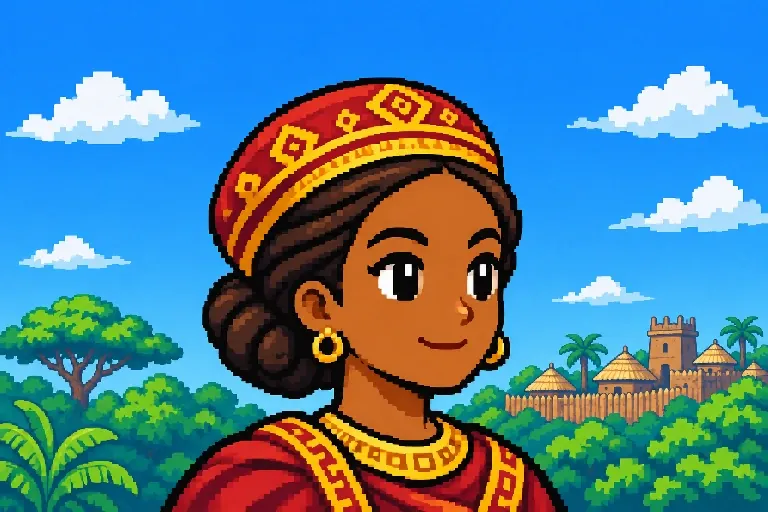
 Njinga Mbande
The small flag beside each name marks the present-day country or region where the person grew up (and, where different, mainly worked). It does not represent the state or flag of their time.
In 1622 a daughter of the king of Ndongo went to Portuguese Luanda, refused to pay tribute and was baptised. Did her brother take poison or was he poisoned, and did she really sit on a maid’s back at the audience — you check the records her enemies and missionaries wrote as you choose the road to the peace that brings her sister home.
Art is illustrative and may differ from in-game visuals.
About this historical figure: Njinga Mbande, baptised Dona Ana de Sousa, was a daughter of the king of Ndongo, in present-day Angola. Succeeding her brother in 1624, she first styled herself “Lady of Angola” and later “Queen”, and she fought and negotiated with the Portuguese and allied with the Dutch against them. From her base in Matamba she built a state, and in 1656 she made peace with Portugal and won back her captive sister.
What you can experience: Four minigames: Weighing the Sources (who wrote it, when and from what position), the Night Crossing at Kindonga (avoid rocks, rapids and crocodiles), Signals of the Ngongo (strike the iron bells) and the Balance of the Terms (keep both your officers and the Portuguese envoy satisfied). Whether you shelter the runaways, talk your brother out of baptism or go back for your captured sister changes later lines and opens new paths.
Historical facts and fiction: This interactive story is inspired by historical events. Dialogue, inner thoughts and alternate choices include fictional elements.
Read more: historical background
Njinga Mbande (c. 1582–1663) died in her capital in Matamba on 17 December 1663, aged about 81. Most records were written by her Portuguese enemies or by missionaries: the “human chair” story, in which she sat on a maid’s back, appears only in a missionary’s account written some forty years later, and historians disagree about it. Likewise, the governor’s first letter says her brother killed himself, while the suspicion of poisoning appears in later reports. In Angola she is honoured as a founder of anticolonial resistance, yet the records also show that while fighting Portuguese slave raiding she herself took part in the slave trade.
Explore the story in the game
Learn about a historical figure, then explore their life in a free browser game with story choices.
Historical evidence and fiction
Dialogue, character motivations and some outcomes are dramatized; distinguish historical evidence from the game’s fiction.
Play the game →