 NAGAYAMA

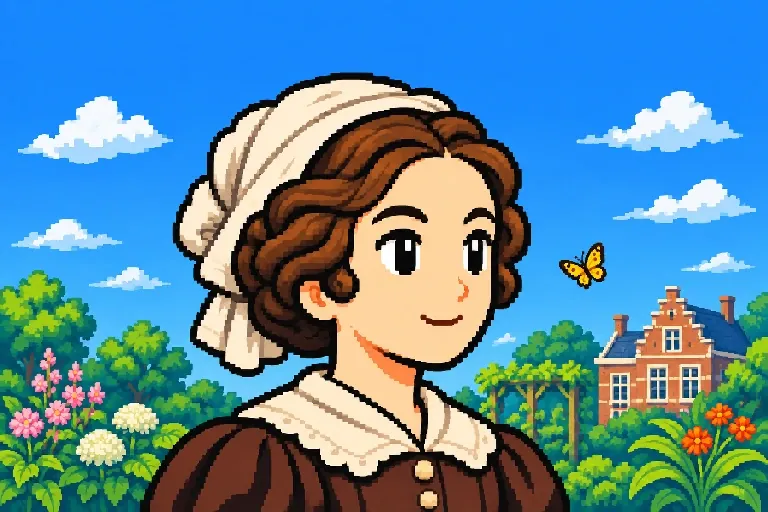

 Maria Sibylla Merian
The small flag beside each name marks the present-day country or region where the person grew up (and, where different, mainly worked). It does not represent the state or flag of their time.
In a Nuremberg where women could not sell oil paintings, she used watercolour, copper plates and rearing boxes to find out what each caterpillar eats and what it becomes. After a religious community and a parting from her husband she sailed to Surinam, where people whose names were never recorded cut her forest paths and told her what the insects were.
Art is illustrative and may differ from in-game visuals.
About this historical figure: Merian was a painter and naturalist born in Frankfurt who learned from her stepfather Marrel and in 1679 published a book showing caterpillars’ transformations with their food plants. After living with the Labadist community she ran a workshop with her daughters in Amsterdam and in 1699 sailed to Surinam with her younger daughter. Her Metamorphosis of the Insects of Surinam (1705) showed the life cycles of tropical insects on sixty copper plates.
What you can experience: You decide what to feed the caterpillars, whether to write the common belief about maggots or wait until you can check, what to bring into the Labadist community, whether to keep local plant names, and whether to record who told you something. Minigames: Days at the Rearing Box, One Plate One Life, The Counterproof and The Name Cards. Earlier choices, bonds and skills change later dialogue and open new options.
Historical facts and fiction: This interactive story is inspired by historical events. Dialogue, inner thoughts and alternate choices include fictional elements.
Read more: historical background
Maria Sibylla Merian (1647–1717). Others studied metamorphosis before her, and her 1679 preface still says maggots arise from rot, so the claim that she alone overturned spontaneous generation is an exaggeration. “Silkworms at thirteen” rests on secondary sources, malaria as the reason for her return is a later guess, and Peter the Great’s visit on the day of her death is a legend. In Surinam she relied on the labour and knowledge of enslaved and Indigenous people without recording their names; this, like the accuracy of her bird-eating spider, is still debated.
Explore the story in the game
Learn about a historical figure, then explore their life in a free browser game with story choices.
Historical evidence and fiction
Dialogue, character motivations and some outcomes are dramatized; distinguish historical evidence from the game’s fiction.
Play the game →