 NAGAYAMA
How foreigners buy property in Niseko
No nationality or visa restrictions, a standard Japanese process — and two Niseko-specific checks (a security-zone notification and your building's rental rules) to make before you sign.
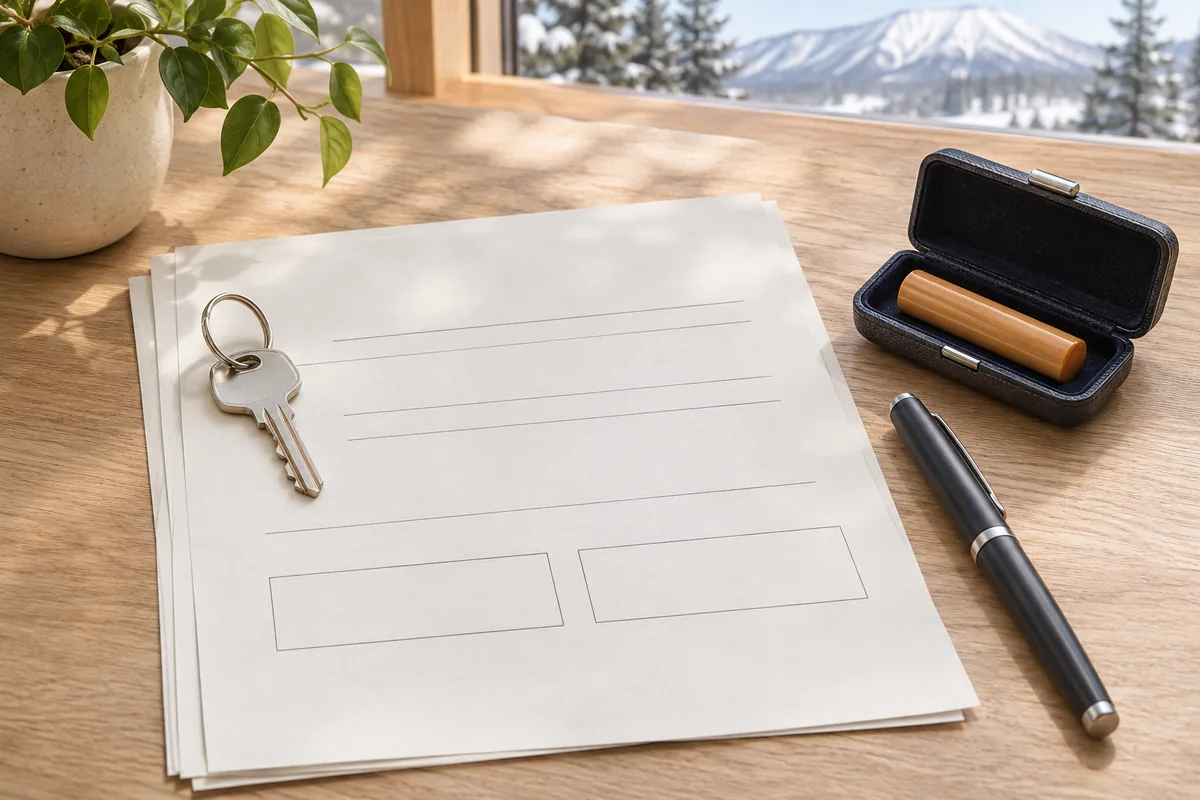
The starting point: you are allowed to buy
Japan does not restrict property ownership by nationality, visa status or residency. A non-resident who has never lived in Japan can own land and buildings outright (freehold), with the same registered title as a Japanese citizen, and can sell or bequeath them freely. There is no approval process for being foreign. What follows is the standard Japanese purchase process, plus the points that specifically catch overseas buyers in Niseko.
The process, step by step
Five steps, in order. Each step says what you do, what you need, what it typically costs and where buyers trip up — so you always know what happens next.
STEP 1Work through a licensed brokerage
- WHAT YOU DO
- Choose a licensed real estate business (宅地建物取引業者) — only a licensed brokerage may mediate a sale in Japan. English-speaking brokerages operate in Niseko and through national portals. View properties, ask about management fees, rental rules and winter costs, and narrow down to the property you want.
- DOCUMENTS
- Passport or photo ID for the brokerage's file. Nothing to file with the government at this stage.
- COST GUIDE
- Nothing is due yet. The brokerage fee is paid at completion (Step 4) and is capped by law — see Step 4.
- WATCH OUT
- Contracts and the legally required "explanation of important matters" are Japanese documents. Use a brokerage that will walk you through them in English, line by line, before you sign anything.
STEP 2Offer and reservation
- WHAT YOU DO
- For a resale property, submit a written purchase application stating your price and conditions. For a new development, file a reservation with the developer instead.
- DOCUMENTS
- The brokerage's purchase application (or the developer's reservation form). Start preparing your signature certificate now (Step 3) — it can take time to obtain overseas.
- COST GUIDE
- A resale application normally costs nothing. New developments may ask for a reservation deposit; the amount and refund terms are set by the developer — confirm them in writing.
- WATCH OUT
- Prices are generally not auction-style, but in a thin resort market expect less negotiation room on well-priced stock, and expect good units to move while you hesitate.
STEP 3Contract
- WHAT YOU DO
- The brokerage delivers the "explanation of important matters" (重要事項説明), then you sign the sale contract and pay the deposit. If you cannot attend in person, the contract can be executed from overseas.
- DOCUMENTS
- A signature certificate — issued by your country's Japanese embassy or a local notary — in place of a registered seal certificate (non-residents cannot obtain the Japanese seal certificate), plus photo ID.
- COST GUIDE
- The deposit is typically around 10% of the price. Stamp duty on the contract runs from ¥10,000 to ¥480,000 depending on the price band (see the Costs page).
- WATCH OUT
- Once you sign, withdrawing usually puts the deposit at stake. Make sure the important-matters explanation covers the building's rental rules and any land-act zone (Step 5 of this guide's checks below) before you sign, not after.
STEP 4Settlement and registration
- WHAT YOU DO
- On the completion date you pay the balance, and a judicial scrivener (shihō shoshi, 司法書士) registers the transfer of ownership at the Legal Affairs Bureau. Registration is what makes the title legally yours.
- DOCUMENTS
- Signature certificate and photo ID again, plus your funds-transfer records — keep them; they support the Step 5 report and your home-country tax file.
- COST GUIDE
- Registration and licence tax (standard rate 2% of the assessed value), the scrivener's fee, and the brokerage fee — capped by law at (price × 3% + ¥60,000) plus consumption tax for prices above ¥4 million.
- WATCH OUT
- International wires can take days and are checked; send the balance early and confirm arrival before the completion date. A missed completion date is a contract problem, not a formality.
STEP 5After completion: filings and setup
- WHAT YOU DO
- File the post-acquisition report (below), set up management and utilities, and put the property's tax bills on a reliable footing — many non-resident owners appoint a tax representative (nōzei kanrinin, 納税管理人) or have their management company handle bills.
- DOCUMENTS
- Two filings catch non-residents out. First, under the Foreign Exchange and Foreign Trade Act, a non-resident buyer must file a post-acquisition report with the Bank of Japan within 20 days of acquisition — since April 2026 this applies to homes bought for your own use as well. Your brokerage or scrivener normally prepares it; confirm it has been filed. Second, since 5 October 2026, registrations include a declaration of the buyer's nationality. It is a declaration for statistics and policy, not an approval and not a purchase restriction.
- COST GUIDE
- Real estate acquisition tax — 3% of the assessed value at the current reduced rate — is billed a few months after purchase. It is a normal bill, not an error.
- WATCH OUT
- The 20-day report deadline runs from acquisition, not from when you get home. Agree who files it, and get confirmation, before you leave Japan or close the file.
Two Niseko-specific checks
1. The Important Land Act zone around Camp Kutchan
Kutchan hosts a Japan Ground Self-Defense Force camp, and land around designated security facilities is covered by the Act on the Review and Regulation of Use of Real Estate Surrounding Important Facilities (the "Important Land Act"). Inside a designated special watch zone, transactions of land or buildings of 200 m² or more require a notification to the government before signing. Most resort purchases are unaffected, but larger land plots near the camp can be inside the zone — have your brokerage confirm the specific plot against the official zone maps. Note also that in autumn 2026 the government put forward a bill to move designated zones toward a permission system regardless of nationality; as of November 2026 that bill had not been enacted. Check the current status before relying on this page.
2. What the building allows you to do with it
If you plan to rent the property out, the constraint is often not the law but the building. Many Niseko condominium management bylaws prohibit minpaku (short-term rental) use outright, and a minpaku licence attaches to an operator, not to the building. Hotel condominiums are let under the hotel's licence instead. Verify — in writing, from the management association's rules — which rental models your specific unit permits before you buy on rental assumptions. The Rentals page explains the models.
The law, in plain terms
You do not need to become a Japanese lawyer to buy safely — but these six points are the legal frame everything else sits in. Where a point depends on your own circumstances, we say so: those are the points to confirm with a professional.
1. Ownership: no restrictions on foreigners
Japanese law does not restrict land or building ownership by nationality, visa status or residency. A non-resident can hold freehold title on the same terms as a Japanese citizen, and can sell, rent out or bequeath the property. The filings described in Step 5 are reports and declarations — none of them is a permission you must obtain to buy.
2. Registration (tōki, 登記): how ownership is proved
Ownership is recorded in the official register kept at the Legal Affairs Bureau (法務局). When you buy, a judicial scrivener files the transfer, and the register is updated to your name; that registration is the public proof of your title against everyone else. You will receive a registration identification notice — keep it safe, as it is needed when you later sell or mortgage the property. An unregistered "private" transfer is not how property changes hands in Japan.
3. Taxes: three moments
Taxes arise when you buy (acquisition tax, registration and licence tax, stamp duty), while you hold (fixed asset tax at 1.4% of assessed value, plus city planning tax of up to 0.3%), and when you sell (capital gains tax; a non-resident seller is generally subject to 10.21% withholding by the buyer, settled later in a Japanese tax return). The Costs page sets out the standard rates. How they apply to you — treaty relief, holding period, corporate versus personal ownership — is individual: confirm with a Japanese tax accountant before you act.
4. The Important Land Act: one zone to check
As set out in the Niseko-specific checks above, land around the Self-Defense Force camp in Kutchan is designated under the Important Land Act, and transactions of 200 m² or more inside a special watch zone need a notification before signing. Whether a specific plot is inside the zone is a factual check your brokerage makes against the official zone maps. A bill to move designated zones toward a permission system was debated in autumn 2026 but had not been enacted as of November 2026 — check the current status at the time you buy.
5. Management companies and building rules
In a condominium, every owner belongs to the owners' association (管理組合) and is bound by its bylaws and monthly fees — including rules that restrict short-term rental. If you will not live in the property, day-to-day care is normally delegated to a management company (管理会社) under a written contract: cleaning, snow clearing, guest handling and bill payment. Fees and what they cover vary by company and building; get the fee schedule and the bylaws in writing before you buy, not after.
6. Checking disaster risk before you buy
Three checks cost nothing. First, ask where the property sits on the municipality's hazard maps (flooding and landslide zones) — hazard-map position is part of what the brokerage must explain in the important-matters briefing. Second, check the public earthquake-hazard maps (J-SHIS) for the area. Third, in Niseko specifically, ask about snow: roof snow load, who clears snow from the roof and driveway, and the cost last winter. None of this replaces a building inspection, but it tells you which questions to ask.
When this page is not enough: tax filings and treaty questions, inheritance and succession planning, buying through a company, and the land-act determination for a specific plot all need a professional — a Japanese tax accountant, a judicial scrivener, or a lawyer — working on your facts. This guide explains the frame; it is not advice on your case.
Registration (登記): the official record of ownership at the Legal Affairs Bureau — the public proof of title Judicial scrivener (司法書士): the licensed specialist who prepares and files registrations Explanation of important matters (重要事項説明): the legally required briefing your brokerage must give you before the contract Fixed asset tax (固定資産税): the annual municipal tax on land and buildings, 1.4% of assessed value Tax representative (納税管理人): a person in Japan you appoint to receive and pay your tax bills while you are abroad
Money practicalities
- Paying from overseas is normal: you do not need a Japanese bank account to buy, and funds are typically wired to the brokerage's or scrivener's escrow arrangement. Keep the transfer records — they support both the foreign-exchange report and your home-country tax file.
- Mortgages are the hard part. Japanese banks generally lend to residents; non-residents without Japanese income usually buy in cash or borrow at home. Details by residency status are in the Japan-wide buying guide.
- Brokerage fee is capped by law: for a price above ¥4 million, (price × 3% + ¥60,000) plus consumption tax, charged by the brokerage that mediates your side of the deal.
If you choose to buy a home in Niseko, we hope you will come to love Japan and take good care of this place — so that Niseko remains a place everyone can enjoy, for years to come.
Ready to talk to a brokerage?
Japan Real Estate is an English-language portal that introduces licensed Japanese brokerages. Bring this checklist with you: registration handled by a scrivener, the 20-day foreign-exchange report, the Important Land Act zone check for land, and the building's rental rules in writing.
Disclosure: this site is an information guide, not a real estate brokerage. We hold no Japanese real estate licence (宅地建物取引業), we never negotiate, mediate or handle contracts or money, and we list no properties. Links marked as introductions are ordinary links today. Japan Real Estate runs a public referral partner program (its link is issued as soon as you sign up); we plan to apply, and when a link is replaced with a referral link this notice will be updated to say so. Any purchase is contracted directly between you and the licensed brokerage.