 NAGAYAMA
Mikazuki Munechika
三日月宗近

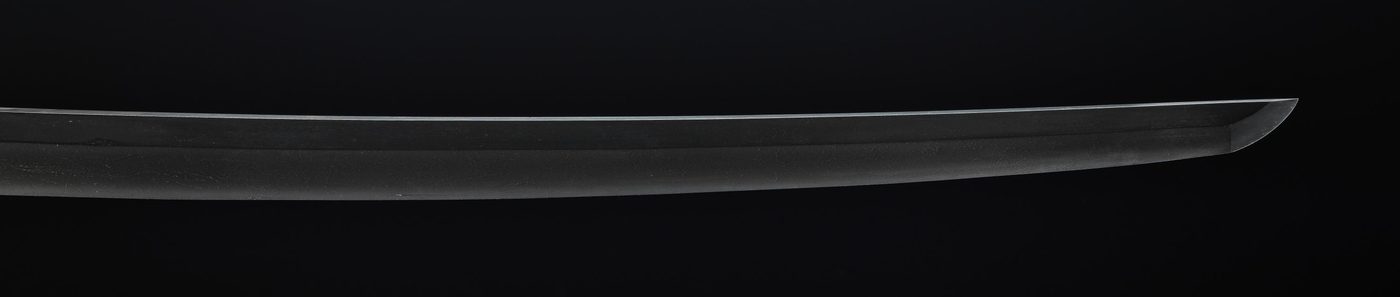
Image from ColBase (https://colbase.nich.go.jp/collection_items/tnm/F-20103-1); resized and recompressed by NAGAYAMA☆LAB. Tokyo National Museum, F-20103-1.
Recorded facts
- A slim tachi with a deep curve. Small crescent-shaped bright marks glint just above the temper line, which the museum gives as the source of the name.
- Munechika is said to have worked in the Sanjō district of Kyoto in the late Heian period; very few of his blades survive.
- It passed from Kōdai-in, wife of Toyotomi Hideyoshi, to the second shogun Tokugawa Hidetada, and stayed with the Tokugawa shoguns for generations.
- Centuries of polishing have made it slender, yet the steel keeps a soft, deep luster.
About the name
From crescent-shaped bright marks in the steel (ColBase).
Record
| Type | Tachi · long sword |
|---|---|
| Smith | Munechika (Sanjō) |
| Signature | Signed "Sanjō" |
| Period | Heian period, 12th century |
| Province | Yamashiro (Kyoto) |
| Designation | National Treasure |
| Collection | Tokyo National Museum |
| Object no. | F-20103-1 |
| Whereabouts | Collection of Tokyo National Museum (per ColBase) |
Being in a museum collection does not mean it is on display now.
What to look for: where the crescents shine
The name Mikazuki Munechika — "Crescent Moon Munechika" — comes from the small crescent-shaped bright marks that appear just above the temper line (hamon). These marks, called uchinoke, are arcs of hardened steel visible in the blade's surface; tilt the blade under light and a row of tiny moons seems to float along the edge. The deeply curved, slender shape is classic for a Heian-period tachi, made slimmer still by centuries of polishing. Its maker, Sanjō Munechika, is said to have worked in the Sanjō district of Kyoto in the late Heian period, and very few of his blades survive. The blade is 80.0 cm long with a curvature of 2.7 cm, per the Agency for Cultural Affairs designation record.
Its journey matches its fame: kept by Kōdai-in, widow of Toyotomi Hideyoshi, it passed as her bequest to the second shogun, Tokugawa Hidetada, and remained with the Tokugawa shogunate for generations. Today it is a National Treasure in the Tokyo National Museum. It is not always on display, so check the museum's exhibition schedule if you hope to see it in person.
Value, and how to read the sword market
To be direct: Mikazuki Munechika itself has no market price. As a National Treasure held by a national museum, it is not for sale, and designated cultural properties of this rank may not, in principle, be taken out of Japan. So how does the market value Japanese swords in general? Read it this way.
Certification moves the price most. The NBTHK (Society for the Preservation of Japanese Art Swords) grades blades as Hozon Token, Tokubetsu Hozon Token, Juyo Token and Tokubetsu Juyo Token, in ascending order; each step up multiplies the value. After papers come the smith and school, the period (Kamakura and other Kotō blades sit at the top), the condition, and the provenance.
For a sense of scale, median asking prices compiled in the Tokyo Nihonto Market Index 2026 — a dataset of 1,625 priced listings from 25 specialist dealers, collected in October 2026 — run, by period, about $5,200–6,000 for Hozon, $9,500–13,900 for Tokubetsu Hozon and $31,600–47,400 for Juyo katana with papers. Those figures are for katana. Tachi such as Mikazuki Munechika generally sit in higher bands at the same paper level — in the same index, the overall median asking price for tachi exceeds that for katana. These are asking prices, not final sale prices (asking prices tend to sit above what blades finally sell for), and individual blades vary widely within each tier. At the other end of the market, most swords that surface from Japanese households are unsigned or by regional smiths, and buyback guides put typical buyback prices there at around ¥50,000–300,000.
Practical notes if you own a Japanese sword: in Japan, possessing or trading one legally requires a registration certificate (jūhō tōkenrui tōrokushō) issued under the Firearms and Swords Control Law; if you acquire a blade, the transfer must be registered with the prefectural board of education within 20 days. Start by checking whether the certificate survives, photograph the blade, and consult a specialist dealer. Never try to remove rust or polish a blade yourself — amateur polishing destroys value. Show it to a specialist as it is. For blades attributed to great smiths such as Munechika, whether NBTHK papers exist makes the decisive difference.
Sources: Tokyo Nihonto Market Index 2026 (tokyo-nihonto.com, dealer asking prices); domestic buyback range from Japanese buyback guides. Checked on 28 November 2026. Prices move; confirm with a specialist dealer or appraisal body before any transaction.