 NAGAYAMA

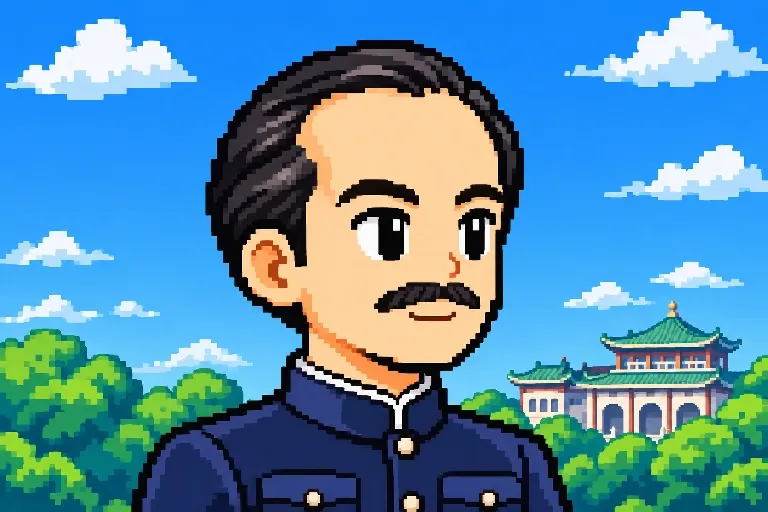
 Sun Yat-sen
The small flag beside each name marks the present-day country or region where the person grew up (and, where different, mainly worked). It does not represent the state or flag of their time.
Schooled in English in Hawaii and top of his class at the Hong Kong College of Medicine, he opened pharmacies in Macau and Canton while choosing the road to overthrow the Qing. He learned of the Wuchang uprising from a morning paper in a Denver hotel, gave up the presidency after three months, and died in Beijing saying the revolution was not yet complete.
Art is illustrative and may differ from in-game visuals.
About this historical figure: Sun Yat-sen was born in Cuiheng village, Xiangshan county, Guangdong, and studied in Hawaii and Hong Kong to become a doctor. He founded the Revive China Society in Honolulu in 1894 and the Tongmenghui in Tokyo in 1905, moving between Hawaii, Japan, Europe and America to raise funds and plan uprisings. In 1912 he became Provisional President of the Republic of China in Nanjing but handed the post to Yuan Shikai after about three months; in his last years in Canton he reorganised the Kuomintang and founded the Whampoa Military Academy.
What you can experience: You choose whether to weigh the villagers’ feelings after breaking the idol, whether to win over the servant Cole inside the London legation, whether to look hard at the motives of your Japanese backers, and whether to stand with the soldiers at the border fort. Minigames: The Western Pharmacy, A Message from the Legation, The Three Principles and A Timeline of the Revolution. Earlier choices and your bonds with Lu Haodong, James Cantlie, Miyazaki Tōten and Soong Ching-ling change later dialogue and open new paths.
Historical facts and fiction: This interactive story is inspired by historical events. Dialogue, inner thoughts and alternate choices include fictional elements.
Read more: historical background
Sun Yat-sen (1866–1925). He wrote that he was kidnapped into the Qing legation in London in 1896, though some research holds that he entered it himself. He was in the United States when the Wuchang uprising broke out in 1911. He set out the Three Principles of the People, died in Beijing on 12 March 1925 and was buried in the Sun Yat-sen Mausoleum in Nanjing. The Republic of China (Taiwan) has called him “Father of the Nation” since 1940, and the People’s Republic of China calls him “the great forerunner of China’s democratic revolution”; he is commemorated on both sides of the strait, but views differ on matters such as how to name his late cooperation with the Soviet Union (“alliance with Russia, admission of Communists” or the “Three Great Policies”) and his idea of political tutelage. His Japanese backers, such as Miyazaki Tōten and Umeya Shōkichi, also acted from differing motives.
Explore the story in the game
Learn about a historical figure, then explore their life in a free browser game with story choices.
Historical evidence and fiction
Dialogue, character motivations and some outcomes are dramatized; distinguish historical evidence from the game’s fiction.
Play the game →