 NAGAYAMA
Annual Events of Japan
Setsubun, Valentine's Day, Hinamatsuri, Tanabata, Christmas — the events that colour the Japanese year each have a meaning, a history and a way to prepare. This section gathers, for every event, its meaning and origins, its customs and etiquette, a preparation checklist, and typical costs with sources, all on one page.
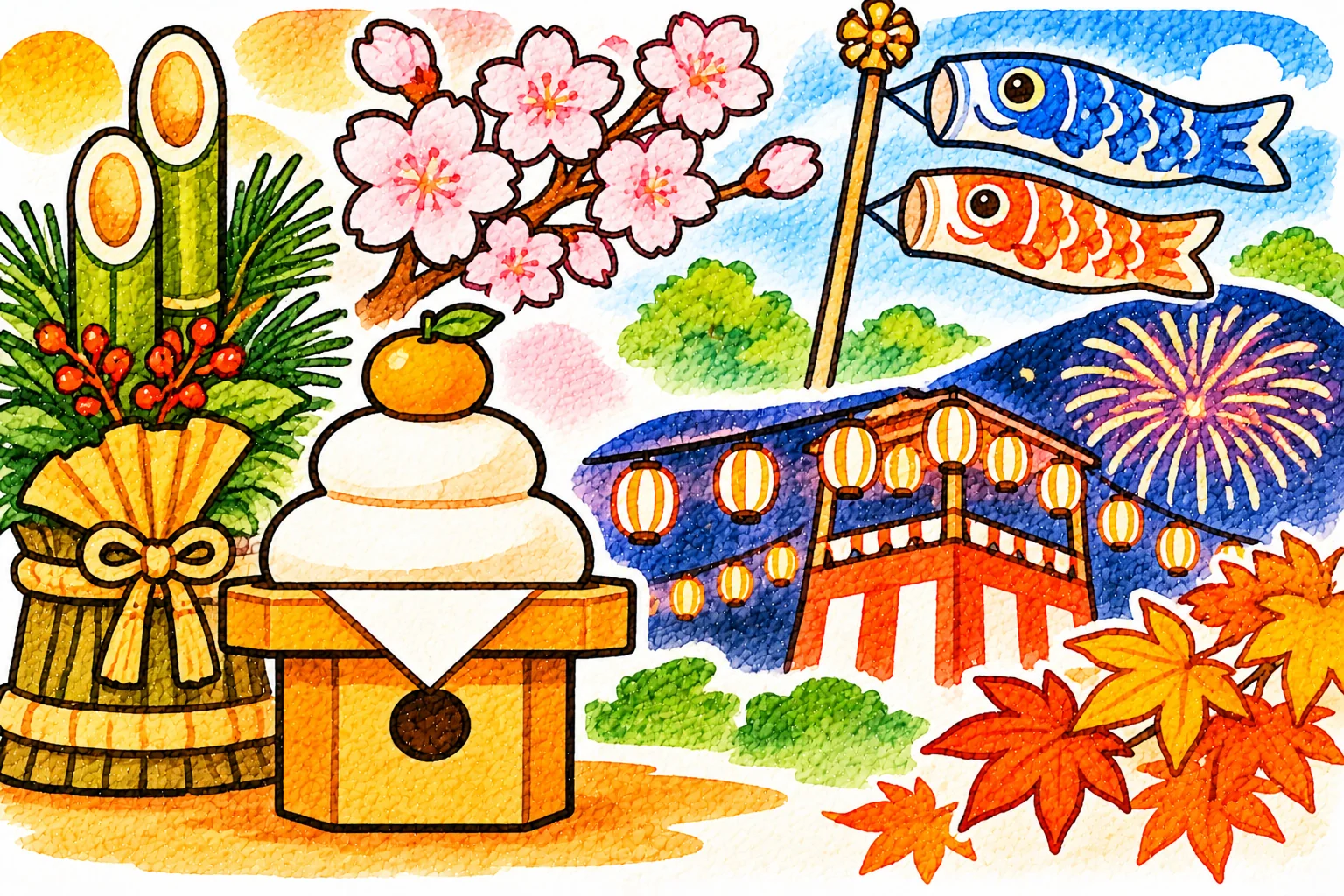
Annual events calendar (in date order)
The Japanese year is shaped by seasonal events. The table below lists the best-known annual observances in date order. Events with a guide are linked. Dates marked "around" move slightly from year to year.
| Date | Event | What is it? |
|---|---|---|
| Jan 1 | New Year (Oshogatsu) | The start of the year, marked by hatsumode (the first shrine or temple visit of the year) and osechi festive dishes |
| 2nd Mon of Jan | Coming of Age Day | Celebrates young people reaching adulthood (age 18 under current law; ceremonies often honour 20-year-olds), many in furisode kimono or hakama trousers |
| Around Feb 3 | Setsubun | Beans are thrown to drive out "demons" (misfortune) and invite luck in; ehomaki sushi rolls are eaten too |
| Feb 14 | Valentine's Day | In Japan it developed its own custom: women give chocolate to men |
| Mar 3 | Hinamatsuri (Doll Festival) | A day to pray for girls' healthy growth, with hina dolls on display |
| Mar 14 | White Day | A Japan-born custom: return gifts for Valentine's Day |
| Late Mar–Apr | Hanami (cherry-blossom viewing) | Eating and strolling under the cherry blossoms, the classic sign of spring |
| 2nd Sun of May | Mother's Day | Thanks to mothers, traditionally with carnations |
| 3rd Sun of Jun | Father's Day | Thanks to fathers |
| Jul 7 | Tanabata (Star Festival) | Wishes are written on paper strips and hung on bamboo, from a legend of two stars |
| Around Aug 13–16 | Obon | A period to welcome and honour the spirits of ancestors; many people travel home |
| Oct 31 | Halloween | Spread mainly among young people as a costume event |
| Nov 15 | Shichi-Go-San | Shrine visits celebrating children aged three, five and seven |
| Dec 25 | Christmas | Not a public holiday in Japan — a festive "event day" of cake, fried chicken and illuminations |
| Dec 31 | Omisoka (New Year's Eve) | The last day of the year: year-crossing soba noodles and temple bells at midnight |
Dates are the usual ones. Some public holidays move to Mondays under Japan's "Happy Monday" system. Setsubun shifts with the first day of spring (see the Setsubun guide).
What this section promises
Meaning and origins first
We explain why each event exists, together with its history, in plain words a first-time reader can follow.
Costs with sources
Prices for cakes and gifts come from published survey data, cited with the date we checked them. Figures are a guide, not a guarantee.
Preparation on one page
Checklists show what to prepare and when, so nothing is left to the last minute.
In Japanese and English
Every guide has both a Japanese and an English version, switchable from the top of the page.
Coming next
Guides for White Day (14 March), Mother's Day (second Sunday of May) and Hinamatsuri (3 March) will follow, in order of the nearest date.